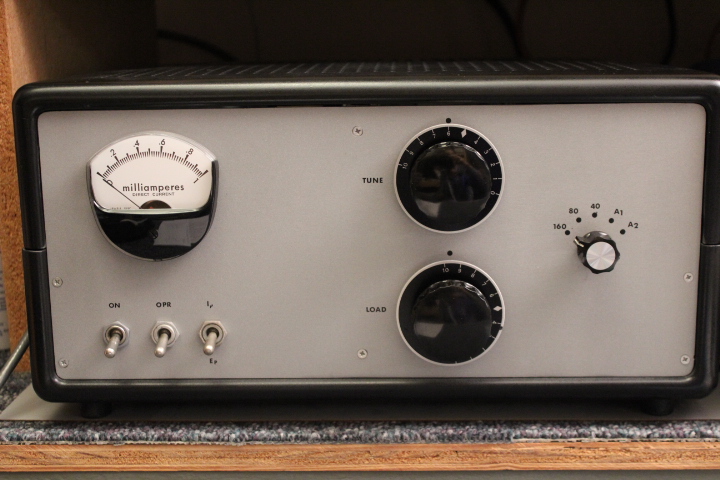
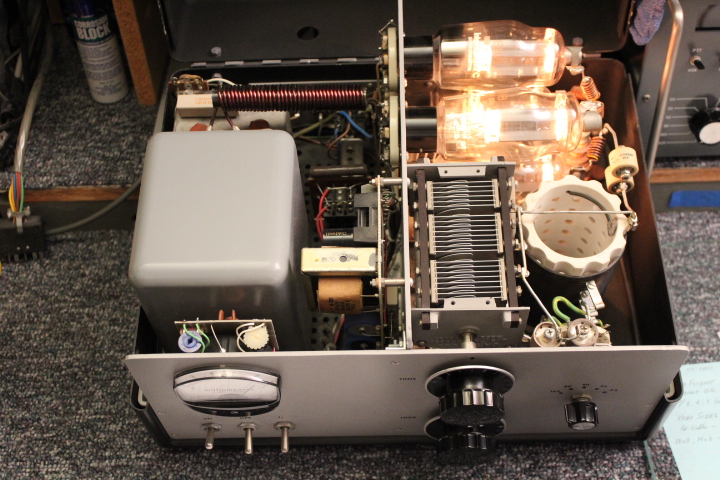
This compact linear amplifier runs a quad of 811-A vacuum tubes in grounded grid, and delivers 600 watts PEP SSB power output
with 48 watts of drive power. It has a band switched plate tank allowing operation of the bands 160 through 20 meters.
The entire unit including its HV Plate Supply is shoehorned into a cabinet measuring 7 x 14 x 12 inches (HWD). I built this
amplifier back in 1991, and at that time Asian mfg. 811-A could be had for $10 each brand new. It still has the origina Jolada
tubes, made in China. RF output power is down a bit after decades of SSB ragchew weekend QSOs' on 160 and 80 meters.
Not visible in this interior photo is a fan just below the 4 vacuum tubes. The fan pulls in cool air from under the cabinet and moves the air straight up to the tubes, and out through ventilation holes in the top of the cabinet.
Success in achieving long service life from 811-A tubes in grounded grid RF linear amplifiers is no accident.
Depending on the amplifier (make, model) the tubes are often "pushed" beyond their maximum ratings. Care must
be taken if long tube life is desired. These are the time honored rules the astute learned operator will follow:
1) The tubes must be matched to insure equal power sharing. Failing to observe this number-1 rule will
guarantee short tube life. My tubes are matched with the aid of a dynamic mutual conductance tube tester,
a U.S. Navy TV-7/U. Reputable tube jobbers will have a method of matching tubes for you. Typically a group of
ten tubes will yield one closely matched set of four, plus a couple of pairs or a trio.
2) Limit drive power to 10 to 12 watts per tube, and use much less for initial coarse tuning. For commercial
amplifiers like Ameritron, use the automatic level control (ALC) connected from the amplifier to the transceiver
to keep drive power within specs. 48 watts into four 811-A will yield a PEP SSB power output of 600 watts.
100 watts of drive will literally light up the grids. I've seen many an abused 811-A with holes burned completely
through grids, when in the hands of the unlearned operator.
3) Make a chart for presetting the PLATE and LOAD tuning controls for frequency bands of interest. This will
speed up band changes and save the tubes from overheating lengthy tune-up procedures.
4) Do not tune the amplifier with a steady carrier. Use low duty cycle method such as a "pulser" into the
transceiver's mic input, or CW keyer sending a high speed string of "dits".
5) Tuning indicator: monitor the amplifier's output with PEP reading watt meter (about 0.2 second Peak Hold),
or a monitor scope / oscilloscope.
6) Tune quickly. Adept operators will take less than 5 seconds each to optimize the amplifier's PLATE and LOAD
tuning controls.
WANTED, RCA 811-A TUBES
Wanted, RCA 811-A: Help, I am in need of replacement tubes for this homebrew amplifier. Over 30 years on the
original set and they are finally going soft. What I have on hand is a pair of JAN RCA 811-A, good used pulls.
They test 50 (over 36) on a calibrated Navy TV-7/U mutual conductance tube tester. I would like to find a pair
that will match them, to make a full set four. Let me know what you have, or if you have a quantity of tubes
and are in need of having them graded for matching into sets, I'll be happy to do that and we'll work something
out in the way of a trade etc. Drop me a note, E-mail is good on QRZ and also: wa4geg [AT] yahoo.com